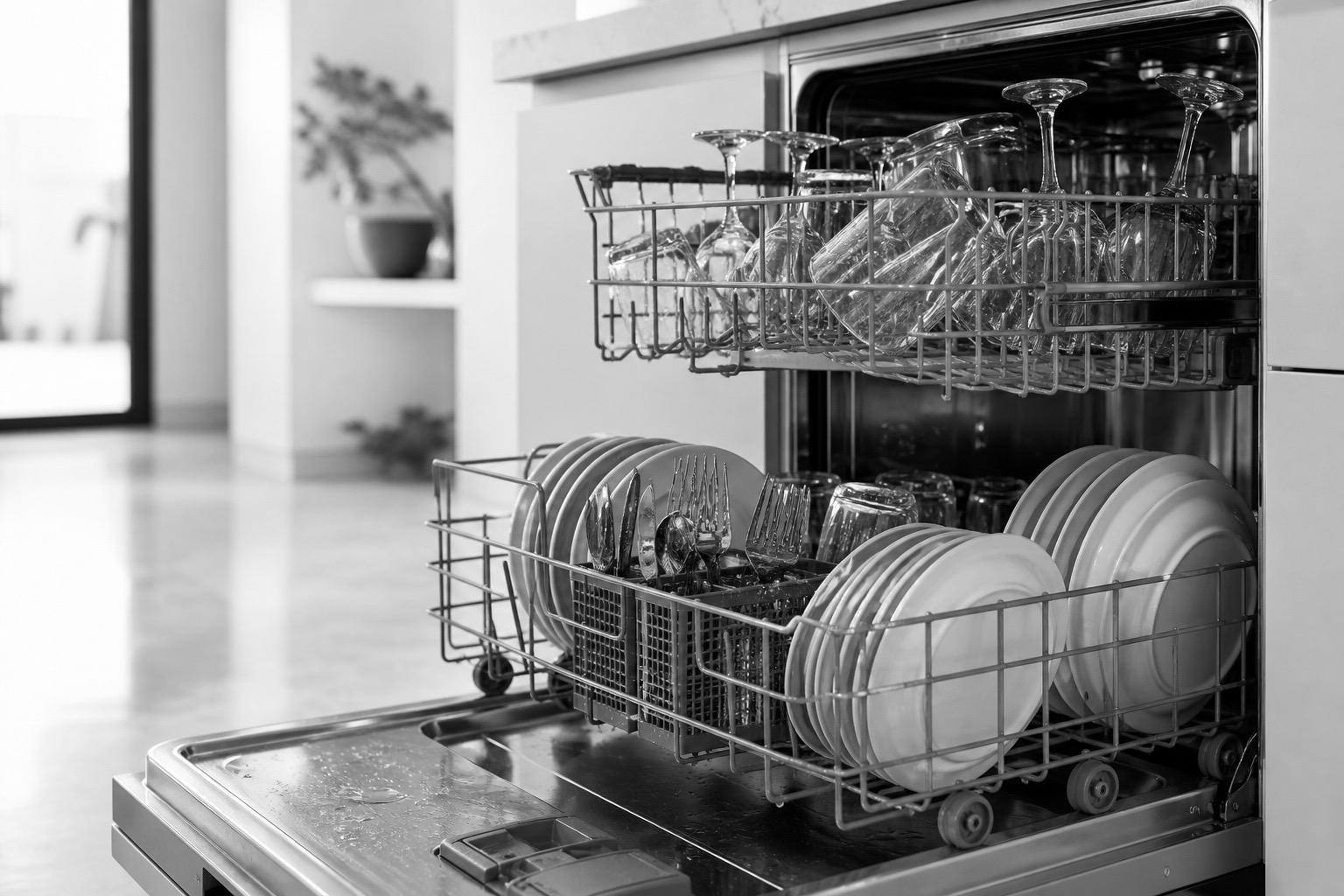
Wet dishes after a cycle usually come down to rinse aid, loading, plastic that cannot hold heat, or a dry option that was turned off. Make sure the tub is actually draining first, then fill the rinse-aid dispenser, adjust how you load, and check the dry setting. If everything comes out wet no matter the material, the heating or sensing side needs a visit.
Drying and draining are easy to confuse because both leave you holding a damp glass. If the tub floor is empty and the plates are only wet, you are in drying territory. If you can splash in the sump, fix drainage first — no drying system can evaporate a puddle that never left.
Many Whirlpool dishwashers dry by heating the last rinse and letting dishes flash off, helped by rinse aid. They are not commercial conveyor machines.
Why does a Whirlpool dishwasher leave dishes wet?
Rinse aid, loading, plastic that holds little heat, and the dry option are the first things to check. If the tub still holds water, fix drainage first.
| Symptom |
What it can point to |
What you can safely check |
| Plastic stays wet, glass and ceramic dry |
Plastic does not hold heat |
Load plastic on the top rack, and on the third level if there is one |
| Spots and droplets on glasses |
Low rinse aid or a low setting |
Refill the dispenser and raise the setting gradually |
| Water pooled on cup bottoms |
Concave items sitting flat |
Angle cups and bowls so water can run off |
| Large loads come out wetter |
Default dry option meant for smaller loads |
Try Extended Dry if your model has it |
| Warm water never seems to arrive |
Supply line not delivering hot water |
Run the kitchen tap hot before starting the cycle |
| Everything wet, including glass |
Heating or sensing may be at fault |
Run the heating-element check below and note any display message |
Drying is not the wash
A cycle can clean well and still leave droplets on plastic because plastic does not hold heat. Angling cups so water can run off matters more than adding a second “extra dry” button you cannot find. Opening the door the moment the beep sounds dumps the humid air onto the dishes; giving it a few minutes helps on condensation-dry models.
What do the dishwasher dry options do?
The manuals describe different dry choices depending on the model. Heat Dry or Pro Dry is typically the default and suits smaller loads. Extended Dry is meant for large loads and adds about 15 minutes. Certain models swap in a Door Open Dry or Natural Dry choice for that purpose. A cycle that ended without heat dry will leave dishes wetter than one with it, so look at what was selected before you suspect a fault.
Check the hot-water side too. The dishwasher heats water during the cycle, but Whirlpool says the supply line should deliver water of at least 120 degrees Fahrenheit. Running the sink tap until it is hot before you start the cycle is a harmless way to help.
Rinse aid and how you load
Fill the rinse-aid dispenser and set it above the minimum if glasses always spot. Nesting bowls block the upper arm. A sheet pan along the back can stop the spray from ever reaching the top rack. These are loading problems that look like “the dishwasher is old.” Whirlpool’s guidance is to load glasses between the tines instead of over them, and to angle concave items so water drains.
How much rinse aid is enough?
Rinse aid helps water sheet off dishes so it dries faster. The dispenser on models described in Product Help holds 5 ounces, and that amount typically lasts 1 to 3 months depending on use. If the dispenser is empty, drying gets worse in a way that looks like a failing machine. For hard water or lingering spots, raise the setting a little at a time instead of jumping to the maximum, and let a few cycles show you the effect.
Loading changes the result as much as any setting. Whirlpool advises keeping plastic off the lower rack, since plastic will not hold the warmth that helps water flash off. Space bowls so none nest, and leave room around each piece so the heated rinse water reaches every surface and flashes off.
When do wet dishes mean a fault?
If every material comes out soaked, the heater may not be running, a sensor may have shortened the cycle, or the door is not sealing. A display message that returns after a reset belongs on the note you leave for a visit. Do not pull the kickplate to stare at wiring.
How do you check the dishwasher heating element?
Whirlpool describes a way to confirm that the heating element is working. On Sanitize models, a steady Sanitize light after a Sanitize cycle means the element is fine, while a blinking light may indicate an element problem. Without a Sanitize option, run a one-hour wash with Heat Dry on a full cycle of about 1.5 hours, then see whether the dishes are warm to the touch when it finishes.
A warm result is reassuring but does not make the dish problem go away. A cold result with wet dishes strengthens the case for diagnosis, and the display message you noted is what a technician will want to see.
Common questions
Why are my plastic items still wet when the glasses are dry?
Plastic and nonstick items hold droplets because they do not retain heat the way glass or ceramic do. Keep them on the upper rack, or the third level if your model has one, and angle them to shed water.
Does rinse aid make a difference to drying?
Yes. Whirlpool says rinse aid improves drying, and a dispenser that has run empty is an easy thing to miss. Refill it, then raise the setting a little if spots persist.
Can I get dishes drier with an extra option?
Some models have Extended Dry, which adds about 15 minutes for large loads. Others have Door Open Dry or Natural Dry, so the control panel and manual for your model show what is available.