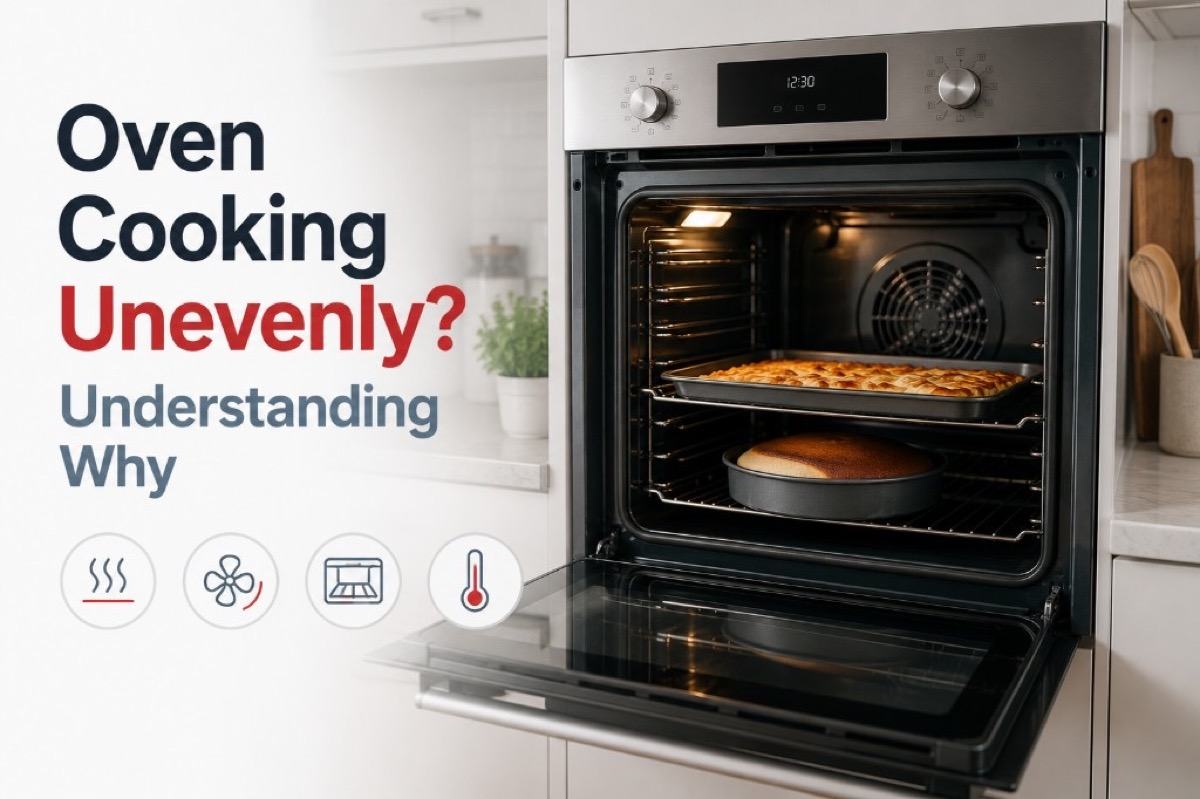
Uneven oven results usually come from preheating, pan color, rack position, or an oven that is not level, long before they point to a failed part. Preheat fully, use a center rack, and give the food room from the walls. If a thermometer shows the cavity is well off the setpoint on several evenings, or the oven shows a burning smell or never heats, stop and book a visit.
Ovens are boxes of moving air and radiating metal. Crowding two trays on a dark sheet in bake mode will brown the bottom and leave the top pale even when the cavity is honest. The same oven can also have a bake element that only glows on one side. You cannot tell which story you are in by one tray of cookies.
Preheat until the oven says it is ready, then wait a little longer if you have been opening the door to “check.” Opening the door often drops the temperature and stretches the bake, which shows up as uneven color.
Why does an oven cook unevenly?
Preheating, pan color, rack position, and an oven that is not level come before a failed part. A bake element that glows on one side is also possible.
| Symptom |
What it can point to |
What you can safely check |
| Top browns, bottom stays pale |
Short preheat, or a shiny pan on a low rack |
Preheat until the oven signals ready and try a lower rack |
| Bottom over-browns |
A dark pan, which browns more than a shiny one |
Switch to a lighter pan or lower the temperature as the pan maker advises |
| One side bakes faster |
Oven not level, or a pan crowding one wall |
Check level with a bubble level and move the pan to center |
| Results change when you open the door often |
Heat escaping during the bake |
Wait for the timer and use the light |
| Thermometer far from the setpoint on several evenings |
Sensor or element in play |
Note the readings and book a diagnosis |
| Smoke from a clean oven during normal cooking |
Residue from past spills |
Wipe cool surfaces; the manual covers self-clean |
Airflow in a closed box
Use a center rack when the recipe allows. Leave space at the walls. A pizza stone that lives in the oven soaks heat and changes how the first tray bakes. Convection mode moves air; bake mode does not. Using the wrong mode for a recipe is not a failed control board.
Pans, foil, and what goes on the racks
Whirlpool’s guidance is clear that dark pans brown more and shiny pans brown less, so the same recipe can bake differently on different bakeware. If bottoms come out pale, move the pan to a lower rack. If bottoms burn, a lighter pan is the fix.
Foil causes a surprising share of uneven results. Do not line the oven bottom with foil or a liner, because that can permanently damage the finish. If you use foil on the rack below a dish to catch drips, it should extend at least half an inch beyond the dish. Never cover an entire rack, since that blocks the movement of hot air the recipe depends on.
Do not block the oven vents either. The manuals for many Whirlpool ranges and wall ovens ask you to keep them clear, because they are part of how air and heat leave the cavity. A pan or foil sheet pushed against a vent opening is an easy way to create hot and cool zones without any part failing.
How do you check the oven temperature against the display?
An inexpensive oven thermometer on the center rack, after a full preheat, is the honest number. If it sits twenty or thirty degrees off the setpoint on more than one evening, the sensor or the element is in play. If it matches the setpoint and food still looks uneven, look at pans and placement first.
How do you test an oven with biscuits?
Whirlpool describes a simple test using refrigerated biscuits. Bake them on the middle rack with about 2 inches of clearance from the walls, after preheating until the oven tone sounds. If your oven has no preheat indicator, the guidance says to allow 12 minutes. When using dark pans, lower the temperature by 25 degrees Fahrenheit.
Judge the result by how evenly the biscuits brown across the pan, not by a single one. An even tray means the cavity is bake-ready and the earlier problem was probably pans or placement. A lopsided tray on a level oven with a good thermometer reading supports the case for a technician’s look at the element or sensor.
How far can you adjust oven calibration?
Some models let you adjust the oven temperature in the controls. The manual guidance is to change it by no more than 10 degrees Fahrenheit at a time and retest after each change. Chasing a big offset with a large calibration number can hide a sensor or element problem that still needs diagnosing, so treat the setting as a small trim and not a repair.
Not every model has this feature, and the steps differ between control styles. Only a model that offers it should be changed. The use-and-care manual for your model shows whether it is available.
When to stop experimenting
A cavity that never heats, a burning smell, or a door that will not close flush is not a rack-position problem. Gas ovens with an odor stay off. Do not pull a wall oven out of the cabinet to inspect wiring.
Common questions
Why is the top of my food brown and the bottom pale?
Whirlpool’s guidance ties that pattern to too short a preheat. Pale bottoms can also improve with a lower rack position and a darker pan, so adjust one thing at a time.
Should I line the bottom of the oven with foil?
No. The manual guidance warns that foil or liners on the oven bottom can permanently damage the finish. If you need to catch drips, set a sheet of foil on the rack below the dish, extending at least half an inch past it.
Does an unlevel oven bake unevenly?
Yes. Whirlpool lists making sure the oven is level among the first things to check for uneven baking, using a bubble level on a rack.