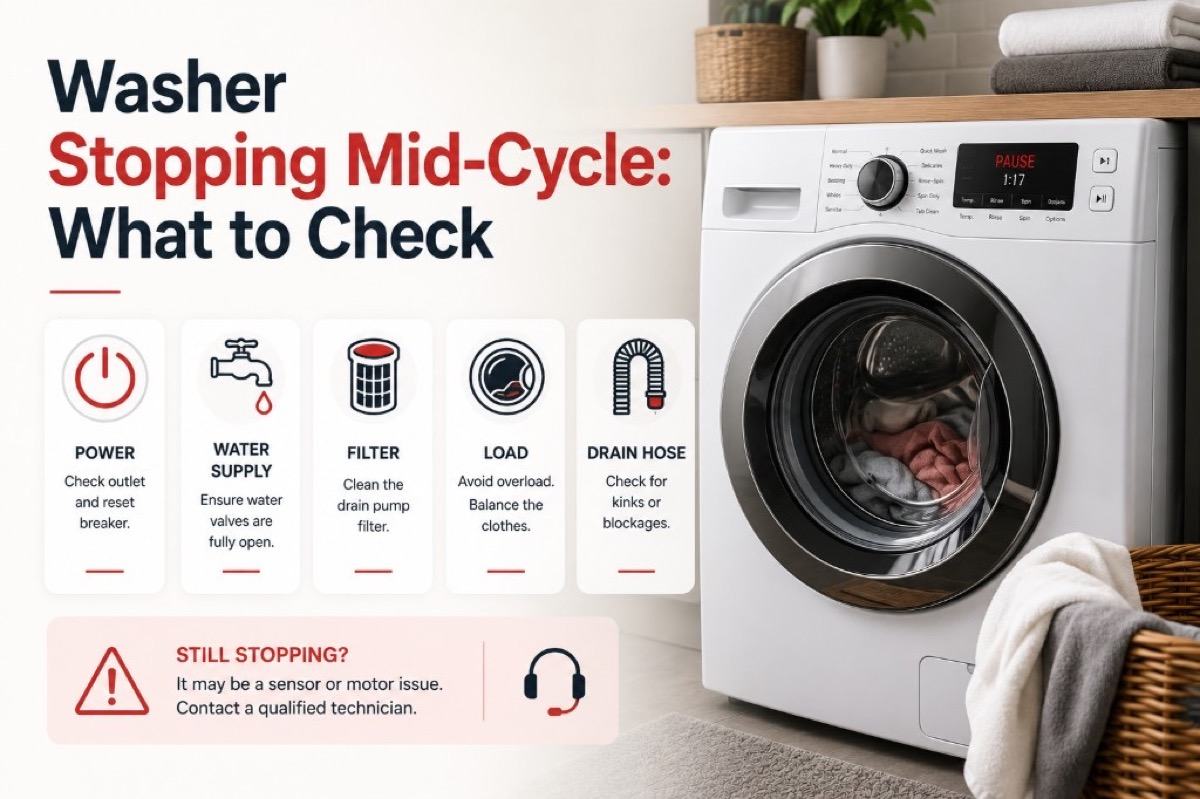
A washer that stops mid-cycle is often waiting on something: a balanced load, a locked lid or door, or water leaving the tub. Check the load, the lid or door, and any message on the display first, and book a visit if the same stop repeats after those basics.
Modern washers pause on purpose: to heat water, to retry a spin, to wait for a drain. One pause is not a failure. A cycle that dies every time at the same point, with water still in the basket, is a pattern worth treating as a fault.
Note whether the door or lid locked, whether you heard a drain attempt, and whether the display showed a message that vanished when you tapped a button.
Why does a washer stop mid-cycle?
Whirlpool Product Help describes an out-of-balance load as a normal reason for noise, vibration, and reduced spin speed. On top-load models, the washer first tries to correct itself by refilling and rocking the basket, and only then shows an error. A cycle that seems stuck may be in the middle of that attempt.
| Symptom |
What it can point to |
What you can safely check |
| Stops with a lot of noise and shaking |
An unbalanced or overloaded load, or an unlevel washer |
Redistribute the load and check that the washer sits level |
| Stops with water still in the tub |
A drain problem, a clogged pump filter, or too many suds |
Check for suds, use only the detergent type the manual names, and clean an accessible filter |
| Lid or door message, or the lock never clicks |
A latch that is not engaging or something on top of the lid |
Clear the lid, close it firmly, and restart |
| Pauses for a long time at the start |
A steam phase, which is slow by design |
Wait before judging; steam models run a phase with no fill or spin |
| A code that appears and clears |
An intermittent fault |
Note the code before touching the controls |
| Nothing responds after a power flicker |
A control waiting for a restart |
Try one power reset and stop if it repeats |
Is a pause mid-cycle always a failure?
Steam and extra-rinse options add waits. An unbalanced load can make a front-loader sit and hum while it tries to redistribute. Open the door only when the lock releases. If you force it, you may get a face full of water. Product Help also notes that a single bulky item can unbalance a load, and an overloaded drum has the same effect. An unlevel washer adds noise and vibration on top of that.
Reading what the display says
Codes differ by model, so match anything you see to your own washer’s manual. Whirlpool lists a few front-load examples: F5 E2 for a door that is not locking, F7 E1 for a motor speed error, F8 E1 for low water flow, and F9 E1 for a drain that takes too long. For F7 E1, the page tells owners to confirm the shipping bolts were removed and the drum is not overloaded.
Top-load high-efficiency models use short codes instead. LdL means the lid will not lock, LdU means it will not unlock, Ofb means the load is unbalanced, and drn means water is not draining. A lid left open also makes the cycle reset and drain after a pause. The message you see is a clue to what the control noticed, not a diagnosis of a part.
Can the lid lock or drain stop a washer cycle?
If the lock never stays engaged, the cycle cannot continue. If the pump never empties the tub, the next spin never starts. Clean an accessible pump filter if your model has a toe-kick door and the manual shows it. Do not yank the drain hose out of the standpipe as a first move on a second-floor laundry.
Can too much detergent stop a washer?
Whirlpool recommends high-efficiency detergent only in HE washers. Regular detergent or too much of it creates suds, which can cause leaking, poor rinsing, and drainage trouble. If the tub is full of foam, the detergent is the first suspect before any part.
For a code that begins with another F and E combination on a front-load washer, the help page suggests unplugging the washer for about five minutes and selecting a cycle again. If the same code returns, stop and book service rather than repeating it. Pause or Cancel pressed twice and then Power once is the documented way to clear a cycle that was paused or canceled.
What does a repeated stop point to?
The same abort after you already redistributed the load, cleaned the filter, and confirmed the hoses are not kinked is motor, pressure sensor, or control territory. Keep the model number from the lid or door frame. Unplug a leaking machine. Telling the technician which code appeared, and at which stage the cycle stopped, narrows the search. A washer that is dripping or leaking should be unplugged and the water supply closed before anything else.
Common questions
Why does my washer stop in the middle of a cycle and not finish?
The usual reasons Whirlpool lists are an unbalanced or overloaded load, a lid or door that did not latch, and a drain that is not emptying. If the stop repeats after you have corrected those, the cause is probably inside the machine.
Is it normal for a washer to pause during a steam cycle?
Yes. On steam models, Whirlpool says the steamer runs for the early part of the cycle with no drum spin or fill, and condensation on the window is expected. Check the manual for how your model behaves before deciding anything is wrong.
What should I do if the washer is full of water and will not drain?
Check for suds and for a kinked hose, and clean the pump filter only if your model has an accessible one that the manual describes. If the water does not move, turn the washer off and book service, and unplug it if there is a leak.