Whether to repair or replace a Whirlpool appliance comes down to what the diagnosis finds, not the calendar. A single failed part on an otherwise sound cabinet usually favors repair, while structural damage, repeat failures, or a part that cannot be obtained for that model point toward replacement.
Homeowners want a rule: if it is more than eight years old, replace it. Cabinets do not read calendars. A Whirlpool washer with a failed lid lock can be a short repair at any age. A refrigerator with a perforated evaporator and a rusted floor is a replacement conversation even if the doors still close.
The useful question is not how old the appliance is but what else is wearing out around the failed part. A good estimate answers that along with the price, and it gives you enough detail to decide rather than just a total.
The honest path is a diagnosis, a price, and a look at the rest of the machine — rust, cracked tubs, damaged glass, unavailable parts — not a slogan.
How do you decide between repairing and replacing a Whirlpool appliance?
Look at the diagnosis, the exact model, and whether the part can be obtained. One failed part on a sound cabinet favors repair; structural damage or repeat failures point toward replacement.
| What the diagnosis finds |
How it tends to weigh |
What to ask |
| One failed part, rest of the appliance sound |
Leans toward repair |
Is the part available for this exact model? |
| Leaking inner tub or rusted floor |
Leans toward replacement, because the next failure is already visible |
What else shows wear around the failed area? |
| Cracked cooktop glass |
Structural damage, leans toward replacement |
Does the crack cross a cooking zone or the edge? |
| Part not obtainable for the model |
Replacement is the practical path |
Is there a different part that fits the same model? |
| Second failure within a short stretch |
Pattern worth weighing |
Is this the same system failing again? |
| Control or pump failure on a clean cabinet |
Leans toward repair |
What does the estimate cover, and is any part under warranty? |
Does age decide whether to repair or replace?
Not by itself. Age is one factor, and how hard the appliance has been used counts as well.
Usage counts. A dryer that ran two cycles a day with a packed vent is older than its years. A lightly used wall oven that needs a sensor is younger than its badge. We will say when the rest of the appliance looks tired even if today’s part is cheap.
Ask what the technician saw besides the failed part. Door gaskets, rust at hinges, cracked plastic, and scorched wiring tell you about the next year better than the model’s age does.
Why does the exact model matter for an estimate?
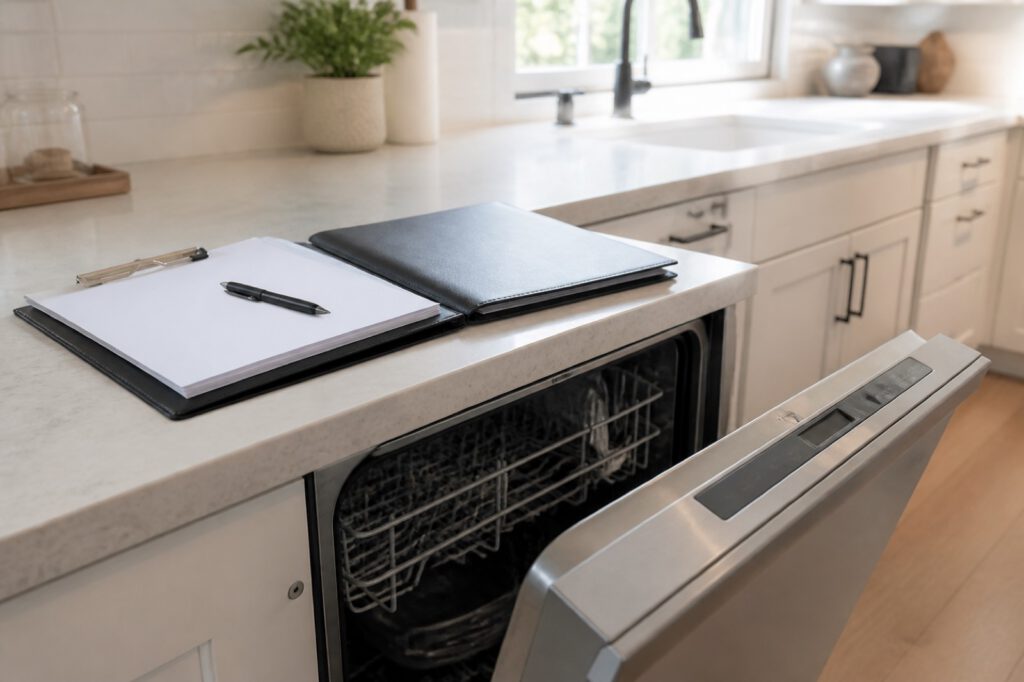
Whirlpool makes many variations of what looks like the same appliance, and parts are matched to the model and serial rather than to a product category. That is why the model label matters during an estimate: it determines whether the right part exists, whether a newer revision of the part fits, and what the appliance was built to do. The label location differs by product; on a dishwasher, for example, Whirlpool’s help pages put the model and serial on the tub frame.
A replacement part that exists for your model is a different decision from a part that has been discontinued. If the answer is uncertain, ask for it to be confirmed in the estimate rather than assumed.
A failed board vs. a failed cabinet
Controls and pumps are replaceable. Inner tubs that leak, cooktop glass that is cracked across a zone, and microwave doors that do not square are structural. Those push the conversation toward replacement because the next failure is already visible. Ask the technician to point to the damage, not just describe it, so you can judge how much of the appliance is affected.
What do repeat failures tell you?
One failure is an event. Two in the same system start to look like a trend. A dryer whose thermal fuse opened once may simply have had a restricted vent, and clearing the vent solves the cause. If the fuse opens again with a clear vent, something else is overheating and the conversation changes.
Likewise a washer that stops mid-cycle after you have balanced the load and cleaned the accessible filter is pointing at motor, sensor, or control territory. Before you approve another repair, ask whether the new failure is related to the old one. Related failures are a stronger argument for replacement than two unrelated ones.
When replacement is the honest answer
If the estimate approaches a sizable fraction of a comparable new appliance, or the part is not obtainable for that model, we will say so. We do not stretch a repair to win a job. You still choose; you should choose with the cabinet in mind, not only the symptom. If the part is available and the cabinet is sound, repair stays a sensible option even when the appliance is not new.
Questions that make estimates comparable
- Does the estimate cover the part, the labor, and any return visit?
- Is the part new, and is it confirmed for your model?
- What else did the technician see that could fail soon?
- If you decline, what happens next?
A replacement also carries decisions of its own: whether the new appliance fits the cutout or space, whether the hookups match, and whether delivery includes removal of the old one. Weigh those against the estimate, not just the repair line.
Frequently asked questions
Is there an age at which a Whirlpool appliance should be replaced?
No single age works for every product. A lightly used appliance with one failed part can be worth repairing, and a heavily used one with structural damage may not be. The diagnosis, the part’s availability, and the condition of the rest of the cabinet matter more than the date on the label.
What kinds of damage push toward replacement?
Damage to the structure of the appliance: a leaking inner tub, cooktop glass cracked across a zone, a door that no longer squares up, or rust that has eaten through the floor of a refrigerator. Control boards and pumps are replaceable parts, while the cabinet around them is not.
Should I decide while the technician is still there?
You do not have to. Ask for the estimate in writing, take time to compare it, and decide when you have the part availability and return-visit terms in front of you.