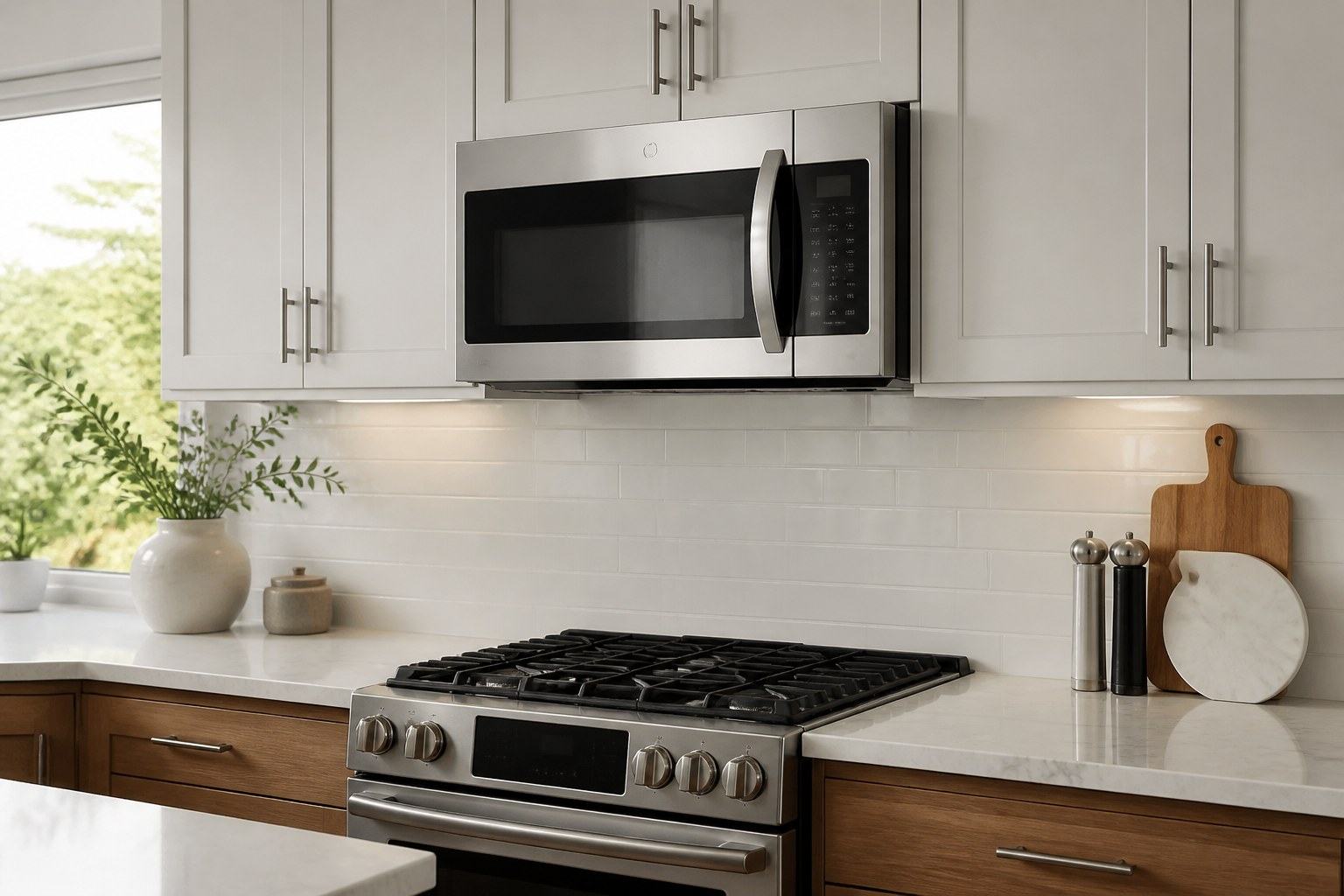
A Whirlpool microwave stays reliable when splatters are wiped off the cavity, the waveguide cover and the door seal before they bake on, and when the turntable and grease filters are washed on a regular basis. If it sparks, smells burnt or runs without heating, stop using it and leave the outer cover on.
Microwaves cook by bouncing energy around a metal box. Food on the ceiling becomes a burn spot. Food on the waveguide cover — the mica or plastic panel on the side wall — becomes a spark. That is why “I’ll clean it later” turns into a service call that looks like a failed magnetron.
Unplug the oven or switch it off at the breaker if it is hardwired. Never remove the outer wrapper to clean “better.”
Is it dirty, locked or actually broken?
A microwave that does not heat is not always a failed part. Whirlpool’s published check is simple: place a cup of water on the turntable, run it for one minute on high, and see whether the water warms. If it does, the oven is heating and the complaint may be about power level, a setting or the food. Lower power levels heat more slowly by design, so a reheating that used to take less time can simply be a reduced setting.
Several settings can also make a working microwave look dead. A control-lock indicator, shown on some models as LOC or a padlock icon, disables the keypad until it is released. A demo mode runs the light, fan and turntable without the heating source. And an inverter or generator supply may run the lights and controls without powering the heating, so the oven belongs in a wall outlet.
Splatters that steal heat
A damp cloth on a cooled cavity handles most messes. For dried sauce, a bowl of water heated briefly to steam the walls, then a wipe, beats scraping. Stay off the door mesh with abrasives; you need that screen intact. Wipe the ceiling and corners as well as the floor of the cavity, since those are the spots splatter is easiest to miss and easiest to leave behind.
| Symptom |
What it can point to |
What you can check |
| Sparks or crackling inside |
Food residue or damage on the waveguide cover, or metal in the cavity |
Stop the cycle, let it cool, and remove metal items; wipe the cavity and cover with a damp cloth |
| Light and fan run, but food stays cold |
A setting such as demo mode or low power, or a heating-source fault |
Run the one-cup water test and check for a control-lock or demo indicator |
| Controls ignore your touches |
Control lock is on |
Look for the lock indicator in the manual and release it the documented way |
| Door does not latch or close squarely |
Residue on the door frame, or damage |
Wipe the seal and frame; stop using the oven if it still will not latch |
| Turntable wobbles or does not turn |
Tray or roller ring not seated, or debris under it |
Lift out the glass tray and roller ring, wash them and reseat them |
How do you clean the microwave turntable and door seal?
The glass tray and roller ring come out on most countertop and over-the-range models. Wash them in the sink. Wipe the door seal so the door still closes square. A door that does not latch is a safety problem, not a cleaning footnote.
Which surfaces cause microwave arcing?
The manuals for Whirlpool microwaves point to the same trouble spots: the cavity walls, the waveguide cover, the rack supports and the contact area around the door frame. Buildup on these places can lead to arcing, so they deserve more attention than the exterior. Do not run the oven empty, keep the turntable in place while cooking, and never put metal foil on a rack.
For cleaning, avoid abrasive pads and steel wool. Some manuals suggest steaming soil loose with a cup of water heated for a couple of minutes, then wiping it away once the oven has cooled, which is gentler than scraping. If the cover shows a burn mark or a hole, cleaning will not restore it, and that needs inspection.
Grease filters under an OTR microwave are hood filters. Wash them. A packed filter does not stop the magnetron, but it does make the vent fan work hotter. If you see sparks, smell burning, or the oven runs without heating, stop using it and leave the cover on.
Which microwave parts need a professional?
Whirlpool’s own guidance describes a failed magnetron or a high-voltage diode as internal parts for a professional, and a damaged door switch can stop the oven from cooking. None of these can be checked by wiping or resetting, and a microwave can hold a dangerous charge even when unplugged. The safe boundary is the outer wrapper: everything inside the cabinet stays closed.
Over-the-range models add a first-use detail. A shipping spacer sits inside the door on new units and should be removed before first use, according to Whirlpool’s help pages. If an installed over-the-range oven acts strangely from the start, that is worth rereading in the manual before assuming a fault.
Common questions
Why is my microwave sparking?
Sparks are often tied to food residue on the waveguide cover or the cavity, or to metal such as foil or a metal rack placed where it should not be. Stop the oven, let it cool, clean the accessible surfaces, and if sparking continues with an empty clean cavity, stop using it.
Is it safe to run a microwave with nothing inside?
No. Manuals for Whirlpool microwaves advise against running the oven empty because there is nothing to absorb the energy. Use a cup of water for any test.
Why does the microwave light up but not heat?
Check for a low power level, a demo mode or a control lock first, then try the one-cup water test. If the water stays cold with the settings correct, the heating source needs inspection, which is not something to open the cabinet for.