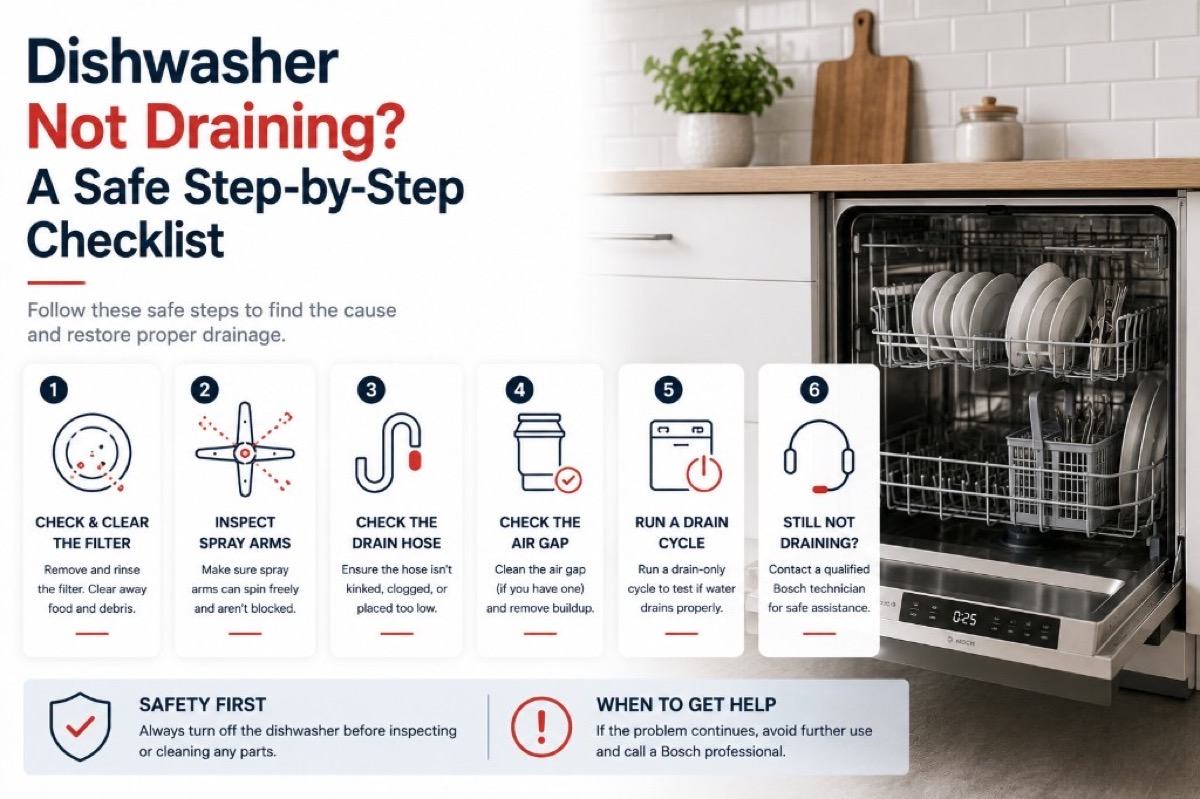
When a dishwasher leaves standing water, work from the easiest cause to the hardest: the filter, the visible drain hose, then the disposer or air gap connection. Cut power first and bail the water out by hand. If the filter is clean, the path is open, and the water returns, stop running loads and book a visit.
Standing water after a cycle is the dishwasher telling you water could not leave the tub. That is a different complaint from wet dishes that drained fine. Start at the filter, then the hose you can see, then the disposer connection. The drain pump is last, and it is not a homeowner disassembly. Whirlpool’s own checklist runs in that same order, from the filter and sump to the hose, the disposal or sink connection, and finally the pump.
Cancel the cycle if it is still running. Let the tub settle. If water is already on the kitchen floor, kill power at the breaker before you reach into the sump. Before you start any of these checks, remove standing water with a cup, a turkey baster, or a hand pump, and keep drain-opening chemicals out of the tub entirely.
How do you work out why a dishwasher will not drain?
Work from the filter to the visible hose, then the disposer or air gap connection. The drain pump comes last and is not a homeowner job.
| Symptom |
What it can point to |
What you can safely check |
| Water sits just above the filter screen |
A partial restriction |
Remove and rinse the filter, then look at the drain hose |
| Water reaches the door opening |
A severe blockage, or a pump that is not running |
Do not run another load; cut power at the breaker |
| Pump hums but water does not move |
A jammed impeller |
Stop; this is past owner care |
| Grinding noise from the pump area |
Hard debris such as glass |
Stop and book a visit; do not probe the pump |
| Water spills from the air gap into the sink |
Blockage downstream of the dishwasher |
Check the hose-to-drain path and the sink plumbing |
| Nothing drains after a new disposer |
Inlet knockout plug left in place |
Have the installer confirm the plug was removed |
Why the puddle is still there
Whirlpool dishwashers recirculate wash water, then pump it out through a hose that usually loops high and ties into a disposer or a drain. Food soil packs the filter. A crushed hose under the cabinet pinches the exit. A disposer that was installed without knocking out the plug blocks the whole path.
Why does the drain hose need a high loop or air gap?
Whirlpool’s guidance says the drain hose needs either a secured high loop under the counter or a working air gap. That arrangement keeps sink water from siphoning back into the tub. A hose that slipped down during other work under the sink, or a loop that was never secured, can cause trouble, and Whirlpool lists keeping the high loop after under-sink work as part of prevention.
The air gap is the small fitting on the counter. If water spills out of it into the sink, that tells you the blockage is further downstream, in the hose-to-drain path or the sink plumbing, not inside the dishwasher. Lifting its cap and clearing the sludge is an occasional job, and it is worth doing before you assume the dishwasher itself is at fault.
What should you check first when a dishwasher will not drain?
With power off, remove the cylindrical filter the way the door-sticker diagram shows. Rinse it from the outside in so debris does not grind into the mesh. Look into the sump for a label, bone, or glass shard — lift those out with fingers or tweezers, not a knife into the pump impeller.
Under the sink, look at the drain hose for kinks and for an air gap on the counter that is clogged with sludge. If you recently replaced a disposer, the dishwasher inlet knockout is a prime suspect.
Whirlpool also lists less common causes, such as a faulty timer, a drain solenoid on older designs, or the control board. Those are diagnosis topics, not owner repairs, which is one reason a filter that stays clean and a hose that stays open shift the question to a visit.
When the puddle is a pump
If the filter is clean, the hose is open, and the disposer connection is clear, a pump that hums without moving water — or stays silent — needs testing. Write down any code on the panel; codes are model-specific, so do not assume a letter-number pair from a different dishwasher applies. Do not run another load that overflows onto the floor.
What does F9E1 mean on a Whirlpool dishwasher?
Many Whirlpool dishwashers report a long drain with the code F9E1. Digital models show F#E# directly. On models with flashing lights, count the first set of flashes for the F number, pause, and then count the second set for the E number. That counting method turns a blinking panel into a code you can write down for the visit.
For F9E1, the steps in the manual are to clean the filter, check the drain hose for kinks, pinches, or clogs, clear the disposer and confirm the knockout plug was removed on a new installation, and clear the air gap. Codes vary by model, so use the chart for yours, and do not treat the message as a diagnosis on its own. It tells you the drain took too long, not which part caused it.
Common questions
Why is there water in the bottom of my dishwasher after it finishes?
The drain path is restricted somewhere, most often at the filter, the hose, or the disposer connection. Cut power, bail the water, and work through those in order.
Can drain cleaner clear a clog in the dishwasher?
The manufacturer’s guidance keeps drain-opening chemicals out of the tub altogether. Remove the water by hand and look for the physical cause.
What should I do before reaching into the tub?
Switch off power at the breaker, not just the control panel, and close the under-sink water valve. Stop and book service for a burning smell, damaged wiring, or a breaker that keeps tripping.